Keeping Up: Tips for Managing Science Reading

August 4th, 2008

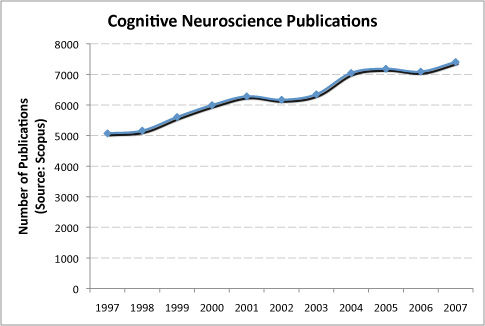
Keeping up with new findings is constantly becoming more difficult with the rate of publication in just cognitive neuroscience increasing by over 200 per year, with an overall increase of 2333 over the last ten years  (see figure below). I will briefly describe some methods I’ve recently discovered to help deal with this onslaught of new information.

I have found that using a combination of computer applications and websites can be effective for keeping up with science readings.

The websites are useful for searching and subscribing to syndicated (RSS) feeds. The applications are useful for organizing articles.

Websites for searching

Google Scholar
This website is extremely useful for exploring a comprehensive collection of research on a particular topic. It uses Google’s legendary indexing algorithms to make keyword searching a breeze, while browsing citation links can reveal a chain of publications on a topic. It’s also useful because citations can be quickly imported into programs like EndNote, and articles that are often unavailable on other websites are made available via Google’s indexing.

Scopus
Scopus is “the largest abstract and citation database of research literature and quality web sources”. It’s very useful for seeing all the papers that have cited a particular article, and all the papers that article has cited. Google Scholar also has this feature, but in my experience there are more false-positives than with Scopus. The consistent link, citation, and abstract-viewing interface makes Scopus often more effective than Google Scholar. Read the rest of this entry »

Grand Challenges of Neuroscience: Day 6

July 21st, 2008

Topic 6: Causal Understanding


Causal understanding is an important part of human cognition.  How do we understand that a particular event or force has caused another event?  How do realize that inserting coins into a soda machine results in a cool beverage appearing below?  And ultimately, how do we understand people’s reactions to events?

The NSF workshop panel on the Grand Challenges of Mind and Brain highlighted the question of ‘causal understanding’ as their 6th research topic.   (This was the final topic in their report.)

In addition to studying causal understanding, it is probably just as important to study causal misunderstanding: that is, why do individuals infer the wrong causes for events?  Or incorrect results from causes? Studying the errors we make in causal inference and understanding may help us discover the underlying neural mechanisms.  

It probably isn’t too difficult to imagine that progress on causal understanding, and improvements in our ability to be correct about causation, will probably be important for the well-being of humanity.  But what kinds of experiments and methods could be used to human brain mechanisms of  causal understanding?

Read the rest of this entry »

A Brief Introduction to Reinforcement Learning

June 2nd, 2008

Computational models that are implemented, i.e., written out as equations or software, are an increasingly important tool for the cognitive neuroscientist.  This is because implemented models are, effectively, hypotheses that have been worked out to the point where they make quantitative predictions about behavior and/or neural activity.

In earlier posts, we outlined two computational models of learning hypothesized to occur in various parts of the brain, i.e., Hebbian-like LTP (here and here) and error-correction learning (here and here). The computational model described in this post contains hypotheses about how we learn to make choices based on reward.

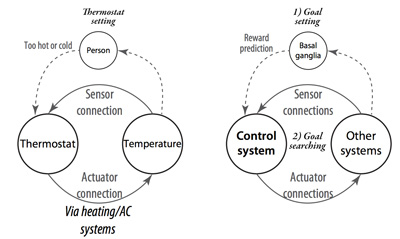
The goal of this post is to introduce a third type of learning: Reinforcement Learning (RL).  RL is hypothesized by a number of cognitive neuroscientists to be implemented by the basal ganglia/dopamine system.  It has become somewhat of a hot topic in Cognitive Neuroscience and received a lot of coverage at this past year’s Computational Cognitive Neuroscience Conference. Read the rest of this entry »

Levels of Analysis and Emergence: The Neural Basis of Memory

May 30th, 2008

A square 'emerges' from its surroundings (at least in our visual system)Cognitive neuroscience constantly works to find the appropriate level of description (or, in the case of computational modeling, implementation) for the topic being studied.  The goal of this post is to elaborate on this point a bit and then illustrate it with an interesting recent example from neurophysiology.

As neuroscientists, we can often  choose to talk about the brain at any of a number of levels: atoms/molecules, ion channels and other proteins, cell compartments, neurons, networks, columns, modules, systems, dynamic equations, and algorithms.

However, a description at too low a level might be too detailed, causing one to lose the forest for the trees.  Alternatively, a description at too high a level might miss valuable information and is less likely to generalize to different situations.

For example, one might theorize that cars work by propelling gases from their exhaust pipes.  Although this might be consistent with all of the observed data, by looking “under the hood” one would find evidence that this model of a car’s function is incorrect.

Read the rest of this entry »

CNS Meeting 2008: Development of Cognitive Control

April 19th, 2008

I just got back from CNS a few days ago. I thought I’d write a quick summary of one of the more interesting symposia at the conference.

Taking place Monday (4/14) afternoon, The rise and fall of cognitive control: Lifespan development covered how executive brain functions develop and peak in the 20s and 30s, falling again toward the end of life.

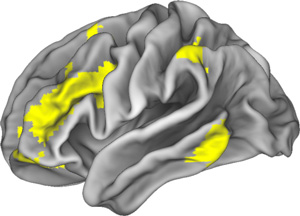
The first talk, by Cindy Lustig, reported on a functional MRI study of 239 individuals ranging from 9 to 97 years of age. She found that the “default-network” brain activity (likely related to mind wandering) was better suppressed during difficult tasks early in life and decreased later in life. This suggests that difficulties older people have with hard tasks may originate in their poor ability to reduce background thoughts.

Adele Diamond gave the next talk, which focused on an impressive preschool program that improves cognitive control in children to help them with future school success. The program, called Tools of the Mind, is based on research showing that self-regulation (i.e., cognitive control) is very predictive of future academic success. The program successfully integrates with the children’s play, and Dr. Diamond’s research shows convincingly that it is able to improve cognitive control and subsequent school success. The above photo is of two children “playing” the program’s ‘Buddy Reading’ task, which promotes inhibition of inappropriate impulses using a reminder icon held by the child in the role of listener (on the right in the above photo).

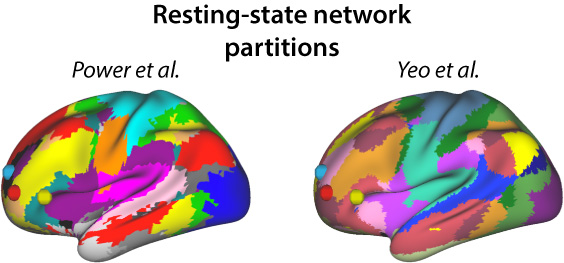
The final talk, by Bradley Schlaggar of Washington University at St. Louis, described tracking changes in resting state connectivity with development. As presented by Steven Petersen at HBM 2007, Dr. Schlaggar showed how dorsal anterior cingulate changes its membership in networks over time. The idea of showing how regional membership in global networks can change with development is very exciting and will certainly lead to future insights into human developmental processes.

-MWCole

Joaquin Fuster on Cortical Dynamics

April 5th, 2008

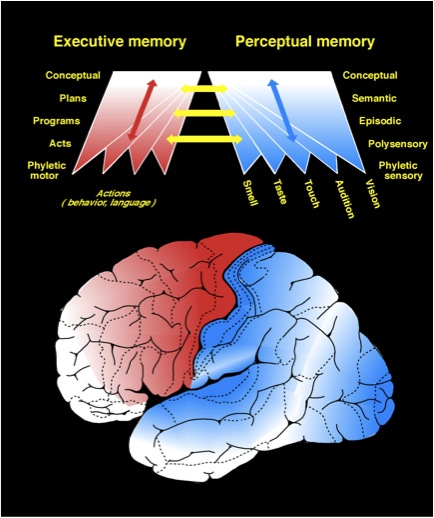
I recently watched this talk (below) by Joaquin Fuster. His theories provide a good integration of cortical functions and distributed processing in working and long-term memory. He also has some cool videos of likely network interactions across cortex (in real time) in his talk.

Here is a diagram of Dr. Fuster’s view of cortical hierarchies:

Joaquin Fuster’s talk:

Link to Joaquin Fuster’s talk [Google Video]

Here is an excerpt from Dr. Fuster’s amazing biography:
Read the rest of this entry »

Combining Simple Recurrent Networks and Eye-Movements to study Language Processing

April 5th, 2008

BBS image of GLENMORE model

Modern technologies allow eye movements to be used as a tool for studying language processing during tasks such as natural reading. Saccadic eye movements during reading turn out to be highly sensitive to a number of linguistic variables. A number of computational models of eye movement control have been developed to explain how these variables affect eye movements. Although these models have focused on relatively low-level cognitive, perceptual and motor variables, there has been a concerted effort in the past few years (spurred by psycholinguists) to extend these computational models to syntactic processing.

During a modeling symposium at ECEM2007 (the 14th European Conference on Eye Movements), Dr. Ronan Reilly presented a first attempt to take syntax into account in his eye-movement control model (GLENMORE; Reilly & Radach, Cognitive Systems Research, 2006). Read the rest of this entry »

Measuring Innate Functional Brain Connectivity

March 29th, 2008

 Functional magnetic resonance imaging (fMRI), a method for safely measuring brain activity, has been around for about 15 years. Within the last 10 of those years a revolutionary, if mysterious, method has been developing using the technology. This method, resting state functional connectivity (rs-fcMRI), has recently gained popularity for its putative ability to measure how brain regions interact innately (outside of any particular task context).

Being able to measuring innate functional brain connectivity would allow us to know if a set of regions active during a particular task is, in fact, well connected enough generally to be considered a network. We could then predict what brain regions are likely to be active together in the future. This could, in turn, motivate us to look deeper at the nature of each brain region and how it contributes to the neuronal networks underlying our behavior.

Rs-fcMRI uses correlations of very slow fluctuations in fMRI signals (< 0.1 Hz) when participants are at rest to determine how regions are connected. The origin of these slow fluctuations has been unclear.

Some have argued that the thoughts and day dreams of participants “at rest” may explain the strong correlations typically found between brain regions. Recently, Vincent et al., 2007 sought to address this possibility using fMRI with anesthetized monkeys.

The idea is that if unconscious monkey brains show low-frequency correlated activity across known brain networks, then such findings in humans at conscious rest are likely not due to spurious thoughts, but something more innate. Read the rest of this entry »

The Will to be Free, Part II

November 6th, 2007

 Several months ago I posted The Will to be Free, Part I. In that post I explained that memory is the key to free will. However, this insight isn’t quite satisfactory. We need three additional things to complete the picture: the ability to choose based on predictions, internal desires, and self-awareness. (A quick disclaimer: These ideas are all extremely speculative. I’ll probably test most of them at some point, but right now I’m just putting them out there to hopefully allow for refinement of these hypotheses.) First, the ability to choose based on predictions. As mentioned last time, free will comes down to decision making. Specifically it comes down to our ability to make a decision based on internal sources (or at least condoned by them), rather than external coercive forces. If we cannot predict the outcome of our decision with any certainty, then decision making is pointless. For instance, if no matter what I choose to order at dinner a random dish is served then I had no freedom to choose in the first place. Thus, our ability to predict is necessary for free will. What are these “internal sources” involved in decision making that I mentioned earlier? They are the second new idea needed to complete our picture of free will: desires. Read the rest of this entry »

The Cognitive Control Network

October 7th, 2007

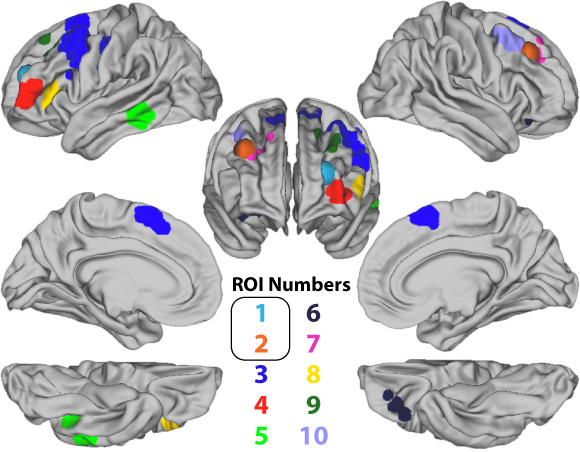
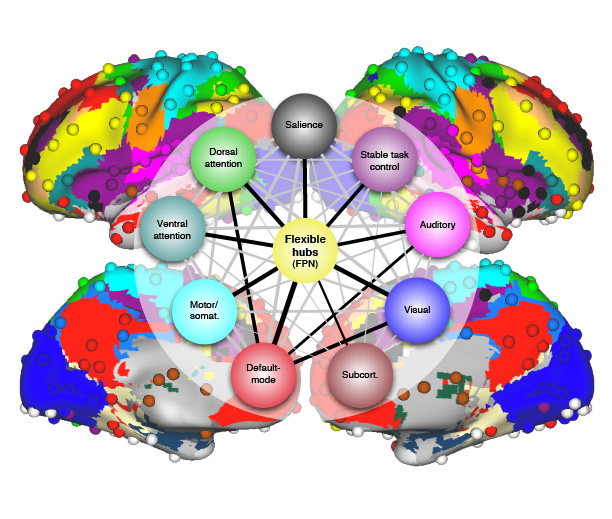
The Cognitive Control NetworkI recently published my first primary-author research study (Cole & Schneider, 2007).

The study used functional MRI to discover a network of brain regions responsible for conscious will (i.e., cognitive control). It also revealed the network’s specialized parts, which each uniquely contribute to creating the emergent property of conscious will.

I believe this research contributes substantially to our understanding of how we control our own thoughts and actions based on current goals. Much remains a mystery, but this study clearly shows the existence of a functionally integrated yet specialized network for cognitive control.

What is cognitive control? It is the set of brain processes necessary for goal-directed thought and action. Remembering a phone number before dialing requires cognitive control. Also, anything outside routine requires cognitive control (because it’s novel and/or conflicting with what you normally do). This includes, among other things, voluntarily shifting attention and making decisions.

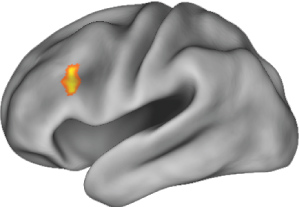
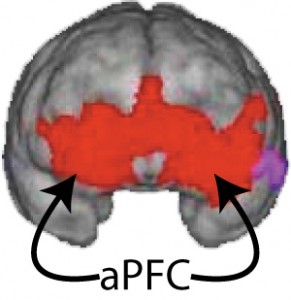
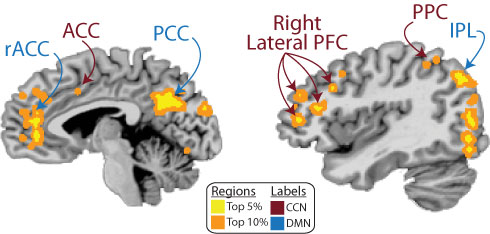
What brain regions are involved? A mountain of evidence is accumulating that a common set of brain regions are involved in cognitive control. We looked for these regions specifically, and verified that they were active during our experiment [see top figure]. The brain regions are spread across the cortex, from the front to the back to either side. However, it’s not the whole brain: there are distinct parts that are involved in cognitive control and not other behavioral demands. Read the rest of this entry »

The role of reward and cognitive control in decision making

September 24th, 2007

Here’s an exchange of emails between PL and MC on a recently published paper (Balleine et al., 2007).

Email 1 (from PL):
Have a look at this introductory paragraph from a recent (Aug 2007) J Neurosci article by Balleine, Delgado and Hikosaka. What do they mean by “cognition” here?

The Role of the Dorsal Striatum in Reward and Decision-Making
To choose appropriately between distinct courses of action requires the ability to integrate an estimate of the causal relationship between an action and its consequences, or outcome, with the value, or utility, of the outcome. Any attempt to base decision-making solely on cognition fails fully to determine action selection because any information, such as “action A leads to outcome O,” can be used both to perform A and to avoid performing A. It is interesting to note in this context that, although there is an extensive literature linking the cognitive control of executive functions specifically to the prefrontal cortex (Goldman-Rakic, 1995; Fuster, 2000), more recent studies suggest that these functions depend on reward-related circuitry linking prefrontal, premotor, and sensorimotor cortices with the striatum (Chang et al., 2002; Lauwereyns et al., 2002; Tanaka et al.,2006).


Email 2 (from MC):

It sounds like they are distinguishing cognition from reward processing. I’m not sure why, since ‘cognition’ typically encompasses reward processing now days.

The distinction I think they’re really trying to make is between cognitive control and reward processing. Given that, it’s still a ridiculous paragraph. Why must it be either cognitive control or reward processing? It’s likely (no, virtually certain!) that the two interact during reward-based decision making. For instance, O’Reilly’s stuff shows how this might happen.

Another problem with this paragraph: They equate causal knowledge with cognitive control. Well-known causal knowledge doesn’t involve cognitive control! For instance, routine decision making would involve lower perceptuo-motor circuits, and if it involved differential reward then reward circuits would be engaged as well. Cognitive control has little/no role here.

When cognitive control is involved it’s probably doing a lot more than just retrieving causal relations from semantic memory. For instance, perceptual decision making studies show that cognitive control is involved even in deciding what is being perceived when uncertainty arises.

I guess what they’re trying to do is show that cognitive control doesn’t explain all of decision making since there must be a reward component as well. Perhaps this is a good point to make; they just didn’t do it well.


Email 3 (from PL):

Ahhh, ok I think I see now what they’re trying to say.  It really just struck me as an excessively divisive statement to start out what appeared to be an interesting article.  Can you say “flamebait”?  Perhaps they’re trying to be provocative.

- PL & MC

Magnetoencephalography

August 20th, 2007

MEG sensors In the dark confines behind our eyes lies flesh full of mysterious patterns, constituting our hopes, desires, knowledge, and everything else fundamental to who we are. Since at least the time of Hippocrates we have wondered about the nature of this flesh and its functions. Finally, after thousands of years of wondering we are now able to observe the mysterious patterns of the living brain, with the help of neuroimaging.

First, electroencephalography (EEG) showed us that these brain patterns have some relation in time to our behaviors. EEG showed us when things happen in the brain. More recent technologies such as functional magnetic resonance imaging (fMRI) then showed us where things happen in the brain.

It has been suggested that true insights into these brain patterns will arise when we can understand the patterns’ complex spatio-temporal nature. Thus, only with sufficient spatial and temporal resolution will we be able to decipher the mechanisms behind the brain patterns, and as a result the mechanisms behind ourselves.

Magnetoencephalography (MEG) may help to provide such insight. This method uses superconducting sensors to detect subtle changes in the magnetic fields surrounding the head. These changes reflect the patterns of neural activity as they occur in the brain. Unlike fMRI (and similar methods), MEG can measure neural activity at a very high temporal resolution (>1 kHz). In this respect it is similar to EEG. However, unlike EEG, MEG patterns are not distorted by the skull and scalp, thus providing an unprecedented level of spatio-temporal resolution for observing the neural activity underlying our selves.

Despite being around for several decades, new advances in the technology are providing unprecedented abilities to observe brain activity. Of course, the method is not perfect by any means. As always, it is a method complimentary to others, and should be used in conjunction with other noninvasive (and the occasionally invasive, where appropriate) neuroimaging methods.

MEG relies on something called a superconducting quantum interference device (SQUID). Many of these SQUIDs are built into a helmet, which is cooled with liquid helium and placed around the head. Extremely small magnetic fields created by neural activity can then be detected with these SQUIDs and recorded to a computer for later analysis.

I recently got back from a trip to Finland, where I learned  a great deal about MEG. I’m planning to use the method to observe the flow of information among brain regions during cognitive control tasks involving decision making, learning, and memory. I’m sure news of my work in this area will eventually make it onto this website.

-MC

Redefining Mirror Neurons

July 17th, 2007

Monkey imitating humanIn 1992 Rizzolatti and his colleagues found a special kind of neuron in the premotor cortex of monkeys (Di Pellegrino et al., 1992).

These neurons, which respond to perceiving an action whether it's performed by the observed monkey or a different monkey (or person) it's watching, are called mirror neurons.

Many neuroscientists, such as V. S. Ramachandran, have seized upon mirror neurons as a potential explanatory 'holy grail' of human capabilities such as imitation, empathy, and language. However, to date there are no adequate models explaining exactly how such neurons would provide such amazing capabilities.

Perhaps related to the lack of any clear functional model, mirror neurons have another major problem: Their functional definition is too broad.

Typically, mirror neurons are defined as cells that respond selectively to an action both when the subject performs it and when that subject observes another performing it. A basic assumption is that any such neuron reflects a correspondence between self and other, and that such a correspondence can turn an observation into imitation (or empathy, or language).

However, there are several other reasons a neuron might respond both when an action is performed and observed.

First, there may be an abstract concept (e.g., open hand), which is involved in but not necessary for the action, the observation of the action, or any potential imitation of the action.

Next, there may be a purely sensory representation (e.g., of hands / objects opening) which becomes involved independently of action by an agent.

Finally, a neuron may respond to another subject's action not because it is performing a mapping between self and other but because the other's action is a cue to load up the same action plan. In this case the 'mirror' mapping is performed by another set of neurons, and this neuron is simply reflecting the action plan, regardless of where the idea to load that plan originated. For instance, a tasty piece of food may cause that neuron to fire because the same motor plan is loaded in anticipation of grasping it.

It is clear that mirror neurons, of the type first described by Rizzolati et al., exist (how else could imitation occur?). However, the practical definition for these neurons is too broad.

How might we improve the definition of mirror neurons? Possibly by verifying that a given cell (or population of cells) responds only while observing a given action and while carrying out that same action.

Alternatively, subtractive methods may be more effective at defining mirror neurons than response properties. For instance, removing a mirror neuron population should make imitation less accurate or impossible. Using this kind of method avoids the possibility that a neuron could respond like a mirror neuron but not actually contribute to behavior thought to depend on mirror neurons.

Of course, the best approach would involve both observing response properties and using controlled lesions. Even better would be to do this with human mirror neurons using less invasive techniques (e.g., fMRI, MEG, TMS), since we are ultimately interested in how mirror neurons contribute to higher-level behaviors most developed in homo sapiens, such as imitation, empathy, and language.

-MC 

Image from The Phineas Gage Fan Club (originally from Ferrari et al. (2003)).

Grand Challenges of Neuroscience: Day 5

July 13th, 2007

Topic: Languagequit_stealing.jpg

Everyday (spoken) language use involves the production and perception of sounds at a very fast rate. One of my favorite quotes on this subject is in "The Language Instict" by Steven Pinker, on page 157

"Even with heroic training [on a task], people could not recognize the sounds at a rate faster than good Morse code operators, about three units a second.  Real speech, somehow, is perceived an order of magnitude faster: ten to fifteen phonemes per second for casual speech, twenty to thirty per second for the man in the late-night Veg-O-Matic ads […]. Given how the human auditory system works, this is almost unblievable. […P]honemes cannot possibly be consecutive bits of sound."

One thing to point out is that there is a lot of context in language.  At a high level, there is context from meaning which is constantly anticipated by the listener: meaning imposes restrictions on the possibilities of the upcoming words.  At a lower level there's context from phonetics and co-articulation; for example, it turns out that the "l" in "led" sounds different from the "l" in "let", and this may give the listener a good idea of what's coming next. 

Although this notion of context at multiple levels may sound difficult to implement in a computer program, the brain is fundamentally different from a computer.  It's important to remember that the brain is massively parallel processing machine, with millions upon millions of signal processing units (neurons). 
(I think this concept of context and prediction is lost on more traditional linguists.  On the following page of his book, Pinker misrepresents the computer program Dragon NaturallySpeaking by saying that you have to speak haltingly, one-word-at-a-time to get it to recognize words.  This is absolutely not the case: the software works by taking context into account, and performs best if you speak at a normal, continuous rate.  Reading software instructions often results in better results.)

Given that the brain is a massively parallel compuer, it's really not difficult to imagine that predictions on several different timescales are taken into account during language comprehension.  Various experiments from experimental psychology have indicated that this is, in fact, the case. 

The study of the brain and how neural systems process language will be fundamental to advancing the field of theoretical linguistics — which thus far seems to be stuck in old ideas from early computer science. 

Experiments?

Because language operates on such a rapid timescale, and involves so many different brain areas, there is need to use multiple non-invasive (as well as possibly invasive) recording techniques to get at how language is perceived and produced such as ERP, MEG, fMRI and microelectrodes. 

In addition to recording from the brain, real-time measurements of behavior are important in assessing language perception. Two candidate behaviors come to mind:  eye movements and changes in hand movements. 

Eye movements are a really good candidate for tracking real-time language perception because they are so quick: you can move your eyes before a word has been completely said.  Also, there has been some fascinating work done with continuous mouse movements towards various targets to measure participant's on-line predictions of what is about to be said.  These kinds of experimental approaches promise to provide insight on how continuous speech signals are perceived.

-PL 

Grand Challenges of Neuroscience: Day 4

July 7th, 2007

After a bit of a hiatus, I'm back with the last three installments of "Grand Challenges in Neuroscience". picture-1.png

Topic 4: Time

Cognitive Science programs typically require students to take courses in Linguistics (as well as in the philiosphy of language).  Besides the obvious application of studying how the mind creates and uses language, an important reason for taking these courses is to realize the effects of using words to describe the mental, cognitive states of the mind.

In fact — after having taken courses on language and thought, it seems that it would be an interesting coincidence if the words in any particular language did map directly onto mental states or brain areas.  (As an example, consider that the amygdala is popularly referred to as the "fear center".) 

It seems more likely that mental states are translated on the fly into language, which only approximates their true nature.  In this respect, I think it's important to realize that time may be composed of several distinct subcomponents, or time may play very different roles in distinct cognitive processes.

Time. As much as it is important to have an objective measure of time, it is equally important to have an understanding of our subjective experience of time.  A number of experimental results have confirmed what has been known to humanity for some time: Time flies while you're having fun, but a watched pot never boils.   
Time perception strongly relates cognition, attention and reward.  The NSF committee proposed that understanding time is going to be integrative, involving brain regions whose function is still not understood at a "systems" level, such as the cerebellum, basal ganglia, and association cortex.  

Experiments?

The NSF committee calls for the develpoment of new paradigms for the study of time.  I agree that this is critical.  To me, one of the most important issues is the dissociation of reward from time (e.g., "time flies when your having fun"):  most tasks involving time perception in both human and non-human primates involved rewarding the participants. 

In order to get a clearer read on the neurobiology of time perception and action, we need to observe neural representations that are not colored by the anticipation of reward.

-PL 

Brain image from http://www.cs.princeton.edu/gfx/proj/sugcon/models/
Clock image from http://elginwatches.org/technical/watch_diagram.html